What other ASM vendors show you:
Your SSL, DNS records, and ports are counted as individual assets. That double counting creates noise and gives analysts more alerts to triage.
Products
Discover how Searchlight Threat & Exposure helps security teams identify hidden risks, prioritize vulnerabilities, and take action before threats become incidents.
Core products
Overview
Case Study
Insurance Company Gains Continuous Visibility over Complex Attack Surface with ASM
Outcomes
Explore how teams use Searchlight to solve real security challenges, streamline investigations, and drive measurable outcomes.
Partners
Discover our partner ecosystem, from technology integrations and channel partnerships to strategic collaborations that extend our security capabilities.
Overview
Partner Types
Company
Learn about Searchlight, meet our leadership team, and discover opportunities to be part of our mission.
Resource Hub
Everything you need to stay ahead. Access datasheets, whitepapers, videos, industry research, and more.
Read
Blog Post
Beacon: AI agents being tested by OpenAI involved in cyber-attack on another service, say researchers
Searchlight Labs
Access original research and technical resources developed by our in-house experts.
Other ASM vendors count metadata as if it’s distinct infrastructure – every SSL certificate, DNS wildcard, and open port – flooding your queue with low-signal alerts that eat your analysts’ time that could be better spent responding to real exposure.
Analyzing asset inflation across 1 root domain...
Based on analysis of our customers’ attack surface data, we estimate that 91% of what’s in your ASM platform is noise – created by duplicate or phantom infrastructure. Here’s why:
Your SSL, DNS records, and ports are counted as individual assets. That double counting creates noise and gives analysts more alerts to triage.
No double-counting here. SSL certificates, DNS records, and ports are tracked as metadata under the root domain – not counted separately.
| Asset Type | Other ASM Vendors (Today) | Searchlight Exposure |
|---|---|---|
| ▤ Subdomains | ||
| ▣ SSL Certificates | Domain metadata(not extra assets) | |
| ◫ DNS Records | Domain metadata(not extra assets) | |
| ◉ Open Ports | Domain metadata(not extra assets) | |
| Total to Monitor |
Searchlight Exposure defines assets logically – minimizing noise and wasted analyst time triaging alerts on phantom assets. Every certificate, DNS record, and port is integrated metadata under the parent host – meaning your team doesn’t lose time on findings that were never a real risk.
Searchlight discovers everything across your exposure fabric, including exposures in third-party tools the rest of the market can’t see yet, with the proof of concept attached.
Catch exposures as they happen – Searchlight discovers and validates exposures on your attack surface every hour.
Searchlight’s research team finds zero-days in enterprise software, turning them into a check the platform, often weeks or months before the public disclosure.
Ready to uncover your true external attack surface?
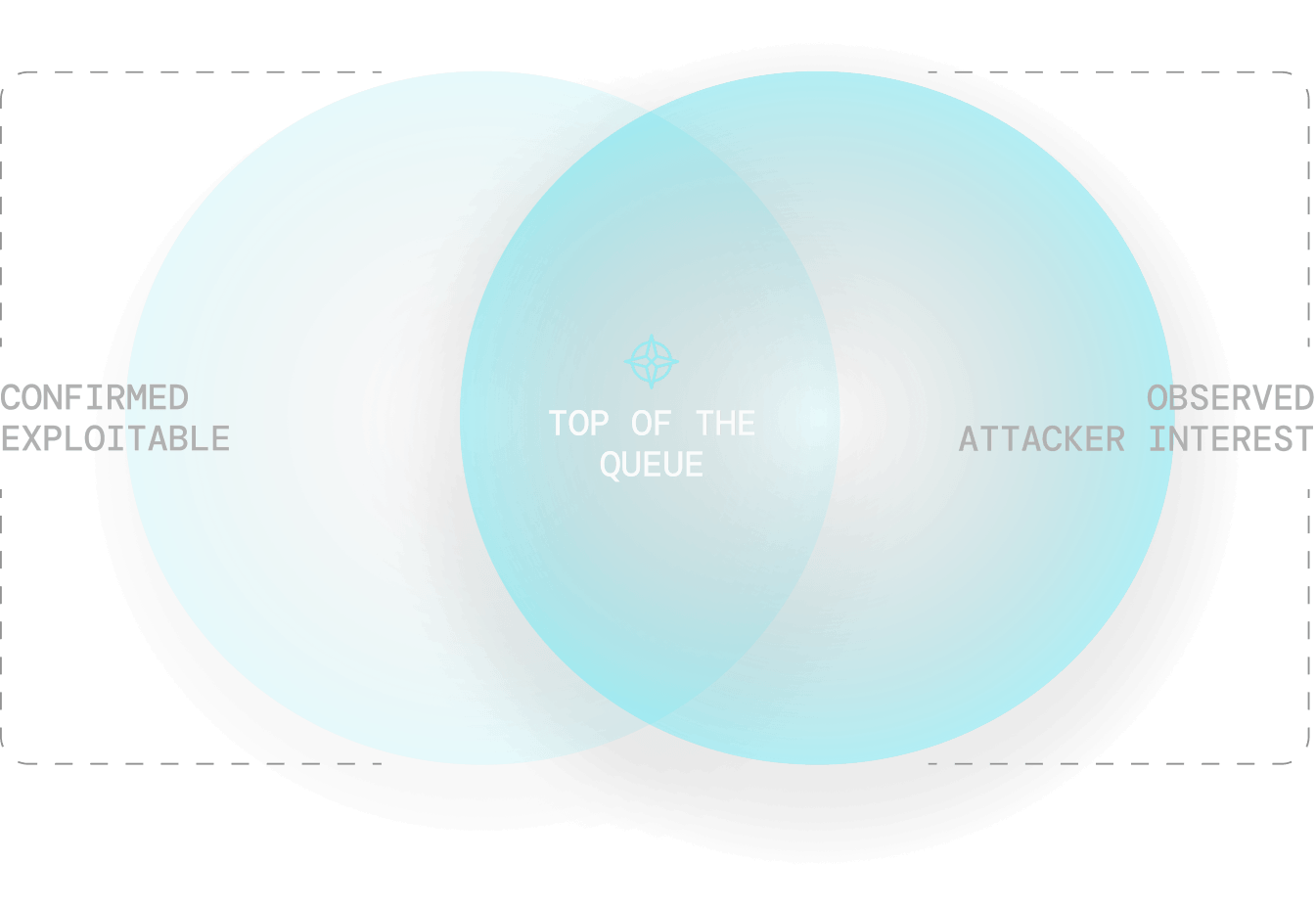
The threats that are both exploitable and actively targeted rise to the top of your queue, so you can resolve them before attackers act. That’s PTEM.

We’ll check for leaked credentials, exposed data, and mentions of your organization on the dark web.
Check Your Dark Web Exposure – Free →“Searchlight gives us the visibility and validation we need to focus on the exposures that actually matter.”